Here's a number that should make every CFO twitch: the average company now spends $4,830 per employee per year on SaaS... up 22% from last year. And they're wasting an average of $21 million annually on unused licenses. That's not a rounding error. That's a line item screaming for attention.
Meanwhile, something interesting is happening on the build side. Retool's 2026 Build vs. Buy Report found that 35% of enterprises have already replaced at least one SaaS tool with custom-built software. And 78% plan to build more internal tools this year. The build-vs-buy equation hasn't just shifted; for a growing number of companies, it's flipped entirely.
This isn't a rebellion against SaaS. SaaS is great for commodity functions. But when your team is duct-taping six different platforms together with Zapier to do something that should be one workflow... that's not efficiency. That's technical debt with a monthly subscription.
The SaaS Sprawl Problem Is Getting Worse, Not Better
The average company manages 275 SaaS applications. Large enterprises with 10,000+ employees? They're running 660 apps and spending $284 million annually on SaaS. Two-thirds of IT leaders reported unexpected charges from consumption-based or AI-adjacent pricing models in the last year alone.
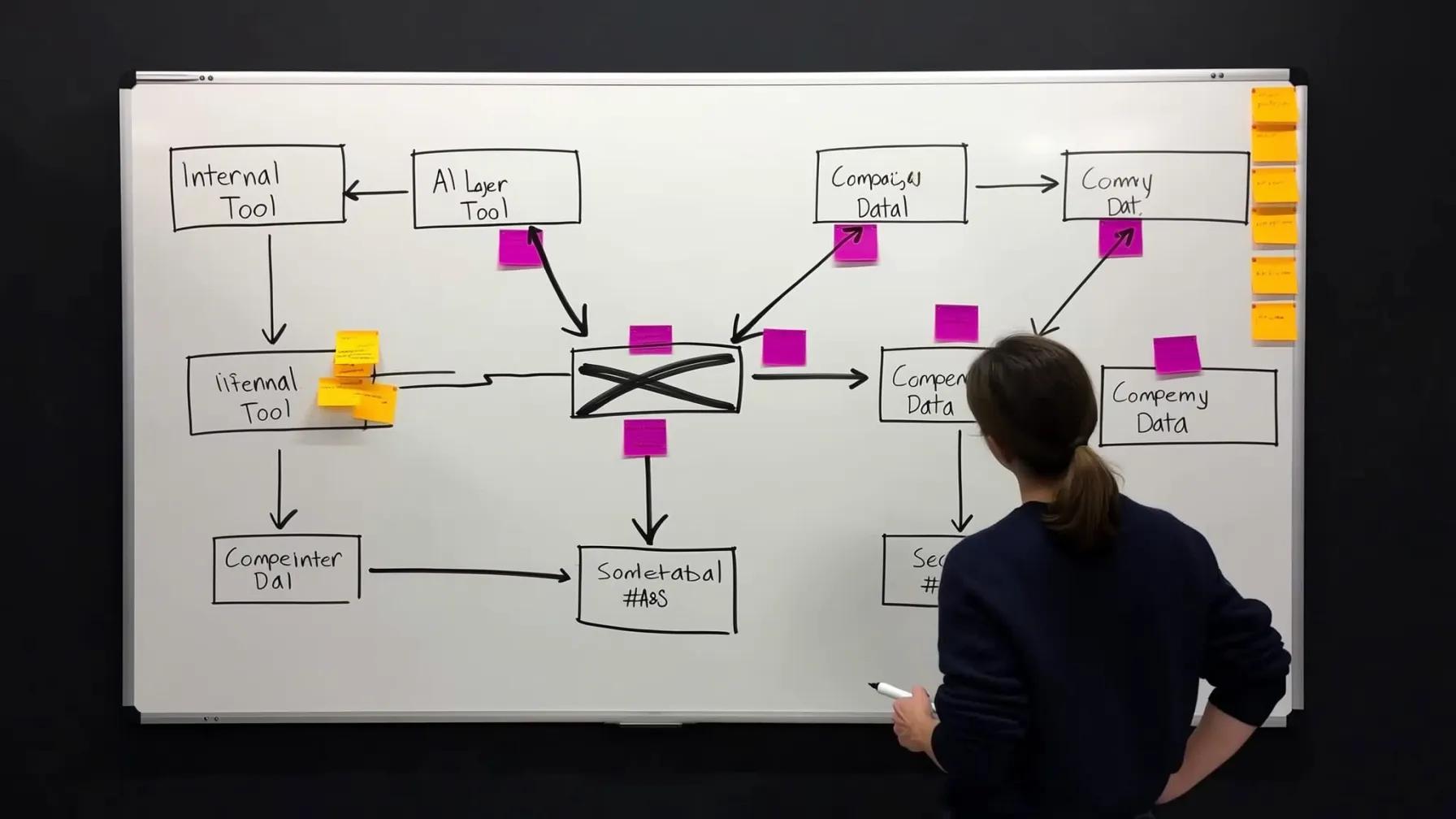
And here's what nobody talks about: SaaS sprawl isn't just a cost problem. It's a data fragmentation problem. Your customer data lives in Salesforce. Your project data lives in Jira. Your communication history is in Slack. Your documents are in Google Drive. Your support tickets are in Zendesk. Each tool is a silo, and the connective tissue between them is either nonexistent or a brittle chain of webhook integrations that nobody fully understands.
When you want to answer a simple question like "which clients are at risk of churning?" you need data from four different platforms, someone who knows how to query each one, and a spreadsheet to stitch it all together. That question should take seconds. Instead, it takes hours... or it just doesn't get answered.
This is the gap that custom AI-powered internal tools fill. Not by replacing every SaaS app in your stack, but by replacing the manual glue work between them with something intelligent.
Why the Economics Shifted
Two years ago, building custom internal tools was expensive and slow. You needed a dedicated engineering team, months of development time, and ongoing maintenance costs that made SaaS look like a bargain. That math has changed dramatically.
Three forces are driving the shift:
AI dropped the cost of building. McKinsey's 2025 State of AI report shows 88% of companies now use AI in at least one business function. But the more relevant number is what's happening to development velocity. AI coding assistants, low-code platforms with AI backends, and agent frameworks mean a small team can now build in weeks what used to take months. Half of the builders in Retool's survey who have shipped production software report saving six or more hours per week.
SaaS pricing keeps climbing. Vendor price hikes, consumption-based billing, and the AI surcharge (where vendors add AI features and raise prices whether you use them or not) mean SaaS costs are growing faster than the value they deliver. When your CRM vendor adds an AI feature you didn't ask for and bumps your per-seat price by 20%, the ROI equation for custom starts looking different.
AI makes custom tools dramatically more capable. Gartner predicts 40% of enterprise apps will feature task-specific AI agents by end of 2026, up from less than 5% in 2025. A custom internal tool isn't just a form that writes to a database anymore. It's a tool that can read your data, reason about it, and take action. That changes what's worth building in-house.
What Companies Are Actually Building
Let's get specific. The internal tools replacing SaaS tend to fall into a few categories, and they share a common trait: they consolidate fragmented workflows into a single, purpose-built interface with AI doing the heavy lifting underneath.
Unified Operations Dashboards
Instead of logging into five tools every morning, teams build a single dashboard that pulls data from all of them. But unlike a traditional BI dashboard, AI-powered versions can summarize trends, flag anomalies, and suggest actions. Think of it as a command center that replaces the manual process of checking each tool individually.
AI-Powered Internal Search
Every company has the same problem: institutional knowledge is scattered across Confluence, Google Docs, Slack threads, and email. Off-the-shelf search tools treat each as a separate silo. A custom internal search tool with RAG (retrieval-augmented generation) indexes everything, understands context, and gives real answers instead of a list of links.
Workflow-Specific Agents
Rather than buying a SaaS tool for every workflow (one for lead scoring, one for report generation, one for meeting summaries), companies are building AI agents that handle specific business processes end-to-end. An agent that reads support tickets, classifies them, pulls customer context, and drafts responses replaces three different tools and the integration layer between them.
Custom CRM and Client Intelligence
Off-the-shelf CRMs are built for everyone, which means they're optimized for no one. Companies with specific sales processes or client management workflows are building lightweight CRMs tailored to exactly how they work, with AI enrichment, automated scoring, and connections to proprietary data sources that a generic CRM would never support.
The Shadow IT Signal
Here's a telling data point from the Retool report: 60% of builders have built something outside of IT oversight in the past year. And a significant portion of those shadow builders are senior managers and above. This isn't junior developers going rogue. This is leadership saying, "I can't wait for IT to provision another SaaS tool that doesn't quite fit."
Retool CEO David Hsu called it a demand signal, not a governance failure. His quote: "Now that vibe coding's gone mainstream, businesses that can custom-build their value drivers will have a competitive edge." The real question, as he put it, is "whether that building happens in a governed environment or in the shadows."
That framing matters. The impulse to build isn't the problem. The lack of infrastructure to support it is. Companies that figure out how to channel this energy... giving teams the tools, guardrails, and support to build custom solutions within a governed framework... will move faster than companies that try to lock everything down.
A Practical Framework for Deciding What to Build
Not everything should be custom-built. That's a recipe for a different kind of sprawl. Here's how we think about which SaaS to keep and which workflows deserve custom tools:
| Signal | Keep the SaaS | Build Custom |
|---|---|---|
| Workflow fit | Tool matches 80%+ of your process | You're fighting the tool to fit your process |
| Data integration | Standalone function, minimal cross-tool data needs | Requires pulling from 3+ data sources |
| AI opportunity | Vendor's built-in AI covers your use case | You need AI that reasons over your proprietary data |
| Competitive value | Commodity function (email, calendar, chat) | Differentiating workflow (how you sell, serve, or operate) |
| Cost trajectory | Stable, predictable pricing | Per-seat costs climbing 15%+ annually |
| Vendor lock-in risk | Easy data export, open APIs | Proprietary data formats, switching costs rising |
The pattern we see: commodity functions stay SaaS. Differentiating workflows go custom. And the glue between everything? That's where AI-powered internal tools deliver the most value per dollar spent.
How to Build Without Creating New Problems
The biggest risk with building internal tools isn't that they won't work. It's that you'll create a new maintenance burden, a new set of shadow systems, or a collection of one-off tools that nobody maintains after the original builder leaves. Here's how to avoid that:
Start With the Workflow, Not the Technology
Map the actual process your team follows today. Not the documented process. The real one. Every shortcut, every workaround, every "I just check Slack for that" moment. The tool should mirror how people actually work, not how someone thinks they should work.
Build on a Composable Stack
Don't build monolithic apps. Build composable components that can be assembled, extended, and swapped. Use provider-agnostic AI abstractions so you're not locked into one model vendor. Use standard APIs so your tools can talk to each other and to the SaaS apps you keep.
Instrument Everything From Day One
Every AI call should be logged with latency, cost, and output quality metrics. Every user action should be tracked. Not for surveillance... for understanding whether the tool actually saves time. Governance and monitoring aren't afterthoughts. They're what keep custom tools from becoming liabilities.
Plan for Maintenance
Every tool you build needs an owner. Not "the engineering team" as a vague collective, but a specific person or team responsible for keeping it running, updating it as APIs change, and improving it based on user feedback. If you can't commit to maintenance, keep it in Zapier.
How We Build AI-Powered Internal Tools at Last Rev
We've been building custom internal tools for years... first for ourselves, then for clients who saw what was possible. Here's our approach:
Discovery sprint (1-2 weeks). We map your workflows, identify the highest-impact SaaS replacement candidates, and design the architecture. This isn't a requirements doc that sits in a drawer. It's a working prototype spec with data sources, AI capabilities, and user flows defined.
Build in iterations (2-4 week cycles). Each iteration delivers a working tool that real users can test. We don't disappear for three months and come back with a finished product. The tool evolves based on actual usage from the first week.
AI-native architecture. Every tool we build has AI baked into the foundation, not bolted on top. That means model routing (use the right model for each task), structured output parsing, graceful fallbacks when models behave unexpectedly, and full observability on every AI interaction.
Integration-first design. Custom tools need to play nicely with the SaaS apps you keep. We build with APIs, webhooks, and event-driven patterns that make your custom tools first-class citizens in your tech stack, not isolated islands.
Handoff and ownership. We build tools that your team can maintain. Clear documentation, clean codebases, and training so your internal team can iterate without depending on us for every change. Long-term maintainability is a design constraint, not an afterthought.
Key Takeaways
- SaaS sprawl is a real cost problem ... $4,830 per employee per year and climbing, with $21M wasted annually on unused licenses at the average enterprise.
- The build-vs-buy equation has shifted. 35% of enterprises have already replaced SaaS with custom builds, and 78% plan to build more in 2026.
- AI is the catalyst. Custom tools aren't just forms and dashboards anymore. They're intelligent systems that can read, reason, and act on your data.
- Not everything should be custom. Keep SaaS for commodity functions. Build custom for differentiating workflows and cross-system intelligence.
- Governance matters. 60% of builders are working outside IT oversight. Channel that energy with infrastructure and guardrails, don't suppress it.
- Plan for maintenance from day one. A custom tool without an owner becomes technical debt faster than the SaaS it replaced.
The companies winning this shift aren't the ones with the biggest engineering teams. They're the ones who figured out which workflows are worth owning and built exactly what they need... nothing more, nothing less.
Thinking about replacing SaaS sprawl with tools that actually fit how your team works? Let's talk about what's worth building.
Sources
- Retool via BusinessWire -- "2026 Build vs. Buy Report: 35% of Enterprises Have Already Replaced SaaS With Custom Software" (2026)
- Zylo -- "2025 SaaS Management Index: Average SaaS Spend, License Waste, and AI Pricing Trends" (2025)
- McKinsey -- "The State of AI in 2025: Agents, Innovation, and Transformation" (2025)
- Gartner -- "40% of Enterprise Apps Will Feature Task-Specific AI Agents by 2026" (2025)
- Newsweek -- "Enterprises Are Replacing SaaS Faster Than You Think" (2026)