88% of organizations now use AI in at least one business function, according to McKinsey's 2025 State of AI survey. But here's the part nobody talks about... only a fraction of those companies have actually integrated AI into their production systems in a way that creates real business value.
Most are still running one-off experiments. A chatbot here. A summarization tool there. The AI lives in a silo, disconnected from the CRM, the ERP, the content pipeline, and every other system that actually runs the business.
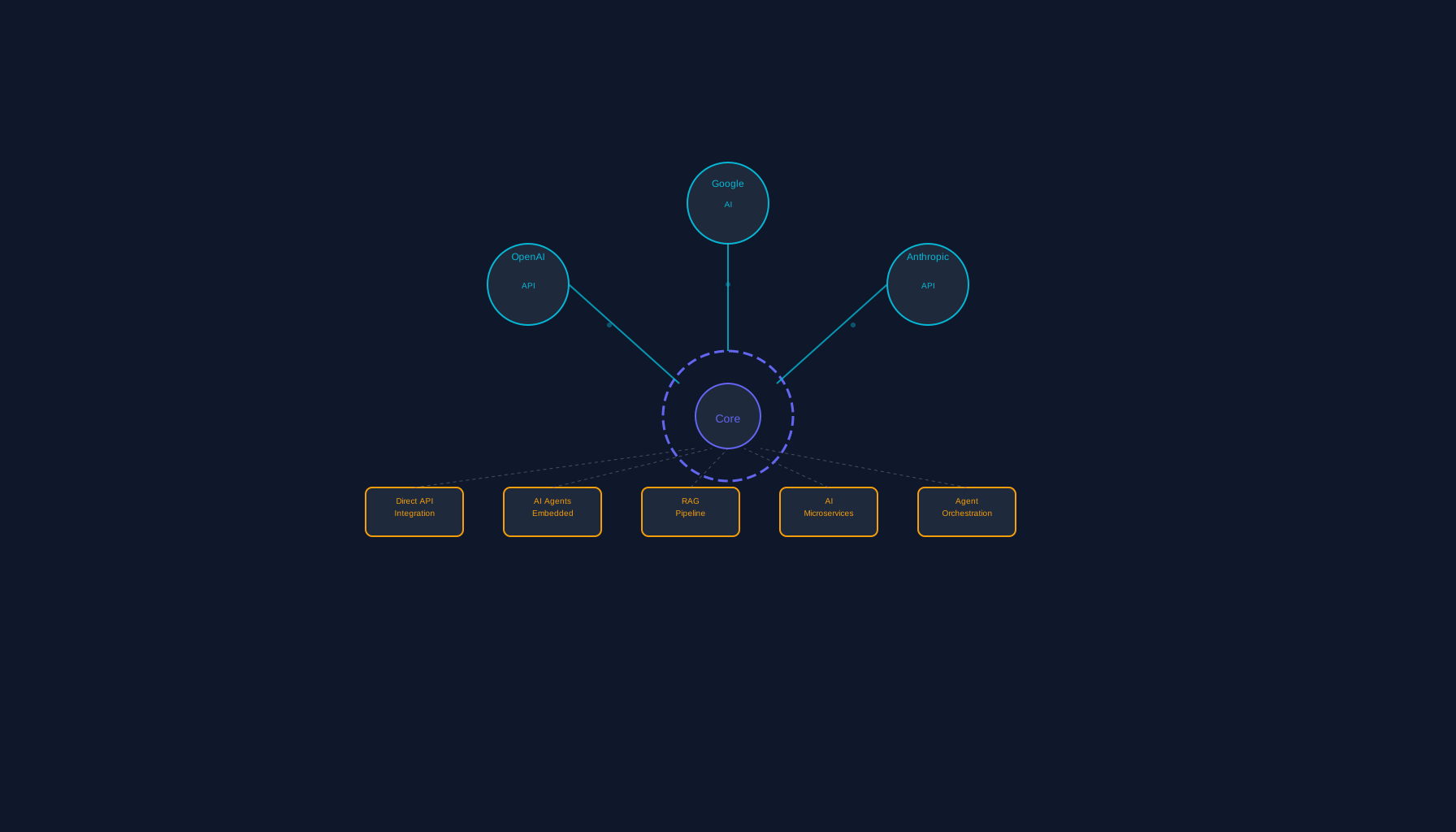
The companies that are winning with AI aren't the ones using the fanciest models. They're the ones who figured out the integration layer. Here are the five patterns we see working in production.
Pattern 1: Direct API Integration
This is where everyone starts, and honestly, it's still the right answer for a lot of use cases. You call the OpenAI, Anthropic, or Google AI API directly from your application code. Simple. Straightforward. Ships fast.
The architecture looks like this: your application sends a request to the provider's REST API, gets a response, and does something with it. Maybe it's generating a product description, classifying a support ticket, or summarizing a document. One request, one response, one model.
Direct API integration works well when you have a single, well-defined task. If you need to classify incoming emails into five categories, you don't need an orchestration layer or an agent framework. You need an API call with a good prompt and a schema for the response.
Where It Breaks Down
The problem shows up at scale. You're hardcoded to one provider. When OpenAI has an outage (and they do), your feature goes dark. When Anthropic changes their API (and they will), you're rewriting code across your entire codebase. When Google offers better pricing for your use case, switching means touching every integration point.
Direct API calls also don't handle the operational complexity that comes with production AI. Rate limiting, token budgeting, response caching, fallback logic... all of that ends up as custom code scattered across your services. It works for one integration. It becomes a maintenance nightmare at ten.
Pattern 2: The AI Gateway
This is the pattern that separates prototype-stage companies from production-ready ones. An AI gateway sits between your applications and the model providers, handling routing, fallback, cost management, and observability in one centralized layer.
Think of it like an API gateway, but purpose-built for AI workloads. Your application sends requests to the gateway using a unified interface. The gateway decides which provider handles the request, manages rate limits, tracks token spend, and logs everything for debugging and compliance.
The enterprise AI gateway market has matured rapidly. By 2026, over 30% of API demand growth is driven by AI and LLM tools, and gateways have evolved from experimental projects to production-critical infrastructure.
Why This Pattern Wins
Three reasons. First, provider flexibility. You can route simple requests to a fast, cheap model and complex reasoning to a premium one. When a provider raises prices, you shift traffic without changing application code. We've seen teams achieve 40-70% cost reductions through intelligent routing alone.
Second, resilience. If Claude goes down, the gateway automatically falls back to GPT-4o. If Gemini's latency spikes, traffic routes elsewhere. Your users never notice.
Third, governance. Every request is logged. Token budgets are enforced at the team and project level. You know exactly who's spending what, and you can set hard limits before costs spiral. Without centralized budget management, production AI workflows can burn through thousands in API costs within hours.
Pattern 3: Retrieval-Augmented Generation (RAG)
Here's the dirty secret of enterprise AI: out-of-the-box models know nothing about your business. They can't answer questions about your products, your policies, your internal processes, or your customer history. They hallucinate confidently instead.
RAG solves this by injecting your proprietary data into the model's context at query time. The flow: user asks a question, the system searches your knowledge base (usually a vector database), retrieves the most relevant documents, and sends them alongside the question to the model. The model generates an answer grounded in your actual data, not its training set.
This is how companies build AI-powered help centers that actually reduce support tickets. It's how internal search tools surface answers from thousands of Confluence pages. It's how commercial AI tools connect to proprietary company data without fine-tuning a model from scratch.
Getting RAG Right in Production
Most RAG implementations fail not because of the model, but because of the data pipeline. Bad chunking, stale embeddings, and missing access controls are the usual suspects.
The teams getting it right follow a few principles. Semantic chunking with contextual headers so the retriever actually finds what's relevant. Hybrid search that combines vector similarity with keyword matching. Document-level access controls so your sales team can't accidentally surface HR documents. And a reranking step that filters out noise before it reaches the model.
The most future-proof RAG systems are also LLM-agnostic by design. Your embedding model and your generation model should be swappable. Today's best retrieval approach might be OpenAI's embeddings; tomorrow it might be an open-source alternative that's cheaper and faster.
Pattern 4: Agent-Based Workflows
This is where things get interesting... and where most teams get into trouble.
An AI agent doesn't just answer questions. It takes actions. It reads from your CRM, writes to your project management tool, sends Slack messages, updates databases, and orchestrates multi-step workflows that used to require a human sitting in front of three different screens.
McKinsey reports that 23% of organizations are already scaling agentic AI systems, with another 39% experimenting. That's over 60% of enterprises actively working on agents. The Model Context Protocol (MCP), which Anthropic open-sourced and later donated to the Linux Foundation, has become the standard for connecting agents to enterprise tools, with 97 million monthly SDK downloads and adoption from OpenAI, Google, and Microsoft.
The Integration Challenge
Agents are powerful, but they introduce a fundamentally different integration model. Instead of request-response, you're dealing with multi-step execution chains where the agent decides what to do next based on intermediate results. That means you need:
- Tool definitions that tell the agent what it can do (and just as importantly, what it can't)
- Guard rails that validate every action before execution, especially for writes and deletes
- Circuit breakers that stop the agent when it's looping or burning tokens without making progress
- Audit trails that log every decision, tool call, and outcome for compliance and debugging
We've written extensively about what it takes to run agents in production. The short version: the demo-to-production gap is about 10x the engineering effort. Budget for it.
Pattern 5: Multi-Model Orchestration
This is the pattern that ties everything together, and it's where the real cost and performance wins live.
Instead of sending every request to one model, you build a routing layer that matches tasks to the right model based on complexity, cost, and speed requirements. Simple data lookups get handled by scripts with zero LLM tokens. Routine analysis goes to a mid-tier model like Claude Sonnet or GPT-4o-mini. Complex reasoning and code generation get routed to premium models like Claude Opus or GPT-4.
Industry surveys suggest the majority of CIOs now run three or more model families in testing or production. This isn't experimentation anymore; it's the default enterprise architecture. Anthropic leads enterprise LLM spend at 40%, OpenAI holds 27%, and Google captures 21%. Together, these three account for 88% of enterprise LLM API usage.
Why Single-Model Is the New Monolith
Running everything through one model is like building a monolith application. It works until it doesn't. You're overpaying for simple tasks and under-serving complex ones. Your costs scale linearly with usage instead of optimizing per task.
Multi-model orchestration flips this. A well-built orchestration layer routes 40% of traffic to deterministic scripts (zero AI cost), handles another 40% with a cost-effective mid-tier model, and reserves premium models for the 15-20% of tasks that genuinely need them. The result is 40-70% lower AI costs with equal or better output quality, because each model handles work it's actually suited for.
Choosing the Right Pattern
These patterns aren't mutually exclusive. Most production systems combine two or three of them. But the starting point depends on where you are.
| Situation | Start With | Add Next |
|---|---|---|
| Single AI feature, one use case | Direct API | AI Gateway when you add more features |
| Multiple AI features, cost pressure | AI Gateway | Multi-model orchestration |
| AI needs access to internal knowledge | RAG | Agent workflows for action-taking |
| Automating multi-step processes | Agent workflows | Orchestration for cost control |
| Running AI at scale across teams | Gateway + orchestration | RAG + agents per domain |
The common thread across all five patterns: don't start with the technology, start with the workflow. Map out the business process you're trying to improve. Identify where AI adds value versus where deterministic code is better. Then pick the integration pattern that fits.
What Most Teams Get Wrong
After building AI integrations across dozens of enterprise environments, here's what we see trip people up most often.
They skip the abstraction layer. Direct API calls feel fast until you need to switch providers, manage costs, or handle failures gracefully. An AI gateway costs a week to set up and saves months of pain later. Get the architecture right first.
They treat AI integration as a one-time project. Models change. Pricing shifts. New capabilities emerge every quarter. Deloitte's 2026 State of AI report found that only 25% of enterprises have moved 40% or more of their AI pilots to production. The gap isn't technology; it's treating AI like a feature instead of an ongoing capability that needs monitoring, tuning, and evolution.
They ignore the data layer. The model is the easy part. Connecting it to your actual business data, keeping that data fresh, enforcing access controls, and handling edge cases... that's 80% of the work. Companies that invest in their data pipeline first get to production faster than companies that start with model selection.
They over-engineer from day one. You don't need a multi-model orchestration layer for your first AI feature. Start with a direct API call. Add complexity only when you have a real reason. The best architecture is the simplest one that solves your current problem while leaving room to evolve.
How We Approach It
At Last Rev, we've settled on a few principles that guide every AI integration project.
First, provider-agnostic from day one. Every integration goes through an abstraction layer. We don't care whether you start with OpenAI, Anthropic, or Google... the architecture supports all three, and switching is a configuration change, not a rewrite.
Second, production-grade or don't bother. We don't ship demos. Every integration includes error handling, fallback logic, cost monitoring, and audit logging. If it can't survive a provider outage without human intervention, it's not ready.
Third, start with the workflow, not the model. We map the business process, identify integration points, and pick patterns that match. Sometimes that means a simple API call. Sometimes it means a full agent pipeline. The answer depends on the problem, not the hype cycle.
The companies getting real value from AI aren't the ones with the most sophisticated technology. They're the ones with the best integration patterns... connecting AI to the systems, data, and workflows that actually run their business.
Sources
- McKinsey -- "The State of AI: Global Survey" (2025)
- Menlo Ventures -- "2025: The State of Generative AI in the Enterprise" (2025)
- Deloitte -- "State of AI in the Enterprise" (2026)
- Maxim AI -- "Top 5 LLM Gateways in 2026 for Enterprise-Grade Reliability and Scale" (2026)
- Anthropic -- "Donating the Model Context Protocol and Establishing the Agentic AI Foundation" (2025)