Every company follows the same AI adoption curve. I've watched it happen at enough organizations now that I can almost set a timer on it. The stages are predictable. The mistakes are predictable. And the way out... that's predictable too, once you know what to look for.
The problem is most companies don't realize they're on a curve at all. They think they're making unique decisions. They're not. They're following a pattern that's been playing out across every industry since ChatGPT hit the mainstream.
Stage 1: Exploration

One person tries ChatGPT. Maybe they use it to draft an email, summarize a document, or generate some code. It works. They show their team. Within a week, half the department has a tab open.
Nobody's talking to IT. Nobody's thinking about data governance. It's just... useful. And that's fine. Exploration is healthy. This is how every technology adoption starts.
The danger isn't in this stage. The danger is what comes next.
Stage 2: Chaos

Different teams adopt different tools. Marketing is using one thing, engineering is using another, sales found some plugin nobody's heard of. Someone built a Zapier automation that nobody understands and nobody can maintain. A manager is worried about data leakage. Nobody's measuring anything.
This is where shadow AI takes root. BlackFog research found that 49% of workers are using AI tools their employer hasn't approved. And it's not just junior employees... 69% of C-suite executives admitted to prioritizing speed over security when it comes to AI tools. The people who should be setting the guardrails are the ones most aggressively bypassing them.
McKinsey's 2025 State of AI report paints the same picture at the organizational level: while 72% of organizations now report using generative AI, only about a third have successfully scaled it beyond experimentation. That means nearly two-thirds of companies are stuck in some version of this chaos stage. Lots of usage, no coherent strategy.
Stage 3: The Panic Buy

The chaos gets uncomfortable enough that an executive decides to bring order. The solution? Buy an enterprise AI platform. Mandate that everyone use it. Problem solved.
Except within a month, people are using ChatGPT secretly anyway. The enterprise platform doesn't fit how they actually work. It's too rigid, too slow, or solves problems they don't have while ignoring the ones they do.
This is expensive. And it's incredibly common. Gartner predicts that over 40% of agentic AI projects will be canceled by the end of 2027 due to escalating costs, unclear business value, or inadequate risk controls. A separate Gartner analysis projected that 30% of generative AI projects broadly would be abandoned after proof of concept.
The pattern is always the same: buy first, ask questions later. The platform becomes shelfware. The shadow AI problem actually gets worse because now people distrust whatever comes from the top.
Stage 4: The Question That Actually Matters
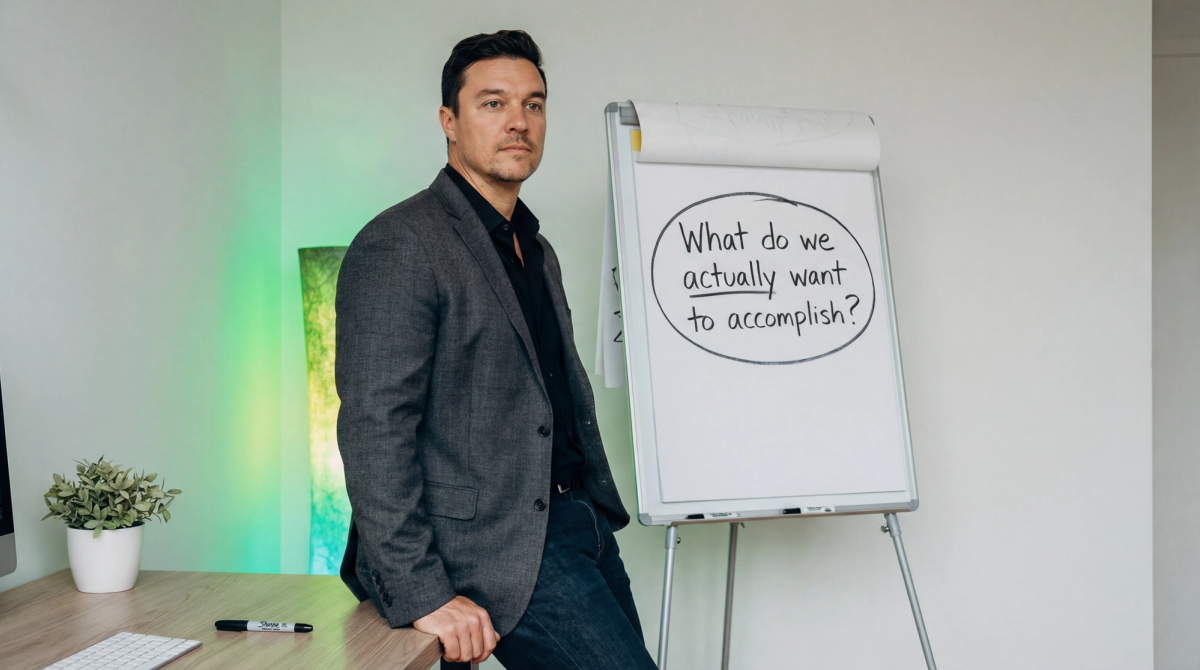
This is where things change. You stop asking "What tool should we buy?" and start asking "What do we actually want to accomplish?"
That shift sounds small. It's not. It changes everything about how you evaluate, build, and deploy AI.
When you start from the outcome, a few things happen:
- You might find the right tool already exists. But you'll use it differently than the vendor intended, because you're solving your specific problem, not the generic one they marketed.
- You might build something custom. Not because custom is always better, but because your workflow has enough nuance that off-the-shelf doesn't cut it.
- You might combine three tools in a way nobody else has. Because your problem is the intersection of processes that no single vendor covers.
- You might decide AI isn't the answer for a particular workflow. And that saves you real money.
The companies McKinsey identifies as "AI high performers"... the roughly 6% generating measurable EBIT impact from AI... all share this trait. They don't start with technology. They start with the business problem. Then they invest in the integration work that connects AI to actual revenue and operations.
Why Most Companies Get Stuck Between Stage 2 and Stage 3
Most companies never reach Stage 4. They bounce between chaos and panic buying, sometimes for years. The reason is straightforward: Stage 4 requires a different kind of work, and most organizations aren't set up for it.
Stage 2 is bottom-up. Individuals solving their own problems. No coordination needed.
Stage 3 is top-down. An executive makes a decision and pushes it out. Coordination by mandate.
Stage 4 is something else entirely. It requires someone to sit down with actual workflows, talk to the people doing the work, understand where time and money are being wasted, and then figure out the right solution. Sometimes that's AI. Sometimes it's not. It's slower and less dramatic than buying a platform. But it's the only thing that actually works.
The companies moving fast on AI didn't get better at tool selection. They got better at deciding what they actually need. That's the work that matters.
What Getting Unstuck Looks Like in Practice
We work with companies stuck in every stage of this curve. Here's what the path forward usually looks like:
- Audit what's already happening. Find out what tools people are actually using, not what they're supposed to be using. The shadow AI is data... it tells you what people need that they're not getting from official channels.
- Pick one workflow that matters. Not the easiest one. Not the most technically interesting one. The one that's closest to revenue or the one burning the most hours. That's where you start.
- Build a working solution in weeks, not quarters. If your AI initiative requires a six-month planning phase, you're in Stage 3 mode. The goal is a working prototype that real people use on real work, fast enough that you can learn from it.
- Measure ruthlessly. Hours saved. Errors reduced. Revenue influenced. If you can't measure it, you can't justify scaling it and you definitely can't prove it to the CFO.
- Own it. Someone has to be responsible. Not a committee. Not a "center of excellence" that meets monthly. A person with the authority to make decisions and the accountability to show results.
This is exactly how we approach AI work at Last Rev. We don't sell platforms. We look at what you're trying to accomplish, figure out the fastest path to a working solution, and build it. Sometimes that means custom AI workflows. Sometimes it means configuring existing tools in ways the vendor never imagined. The answer depends entirely on the problem.
The Real Cost of Staying Stuck
The cost of bouncing between Stage 2 and Stage 3 isn't just wasted software licenses. It's lost time. McKinsey estimates $2.6 to $4.4 trillion in annual value potential from AI across 63 use cases. That value doesn't accrue to companies that are still debating which platform to buy. It accrues to the ones that picked a problem, built a solution, and started compounding their advantage.
Every month you spend in the chaos loop is a month your competitors are learning what works. AI compounds. The teams using it effectively today aren't just ahead... they're pulling away.
If you're in Stage 2 or Stage 3 right now, the way forward isn't another tool. It's clarity on what you're trying to do and who owns it. Everything else follows from that.