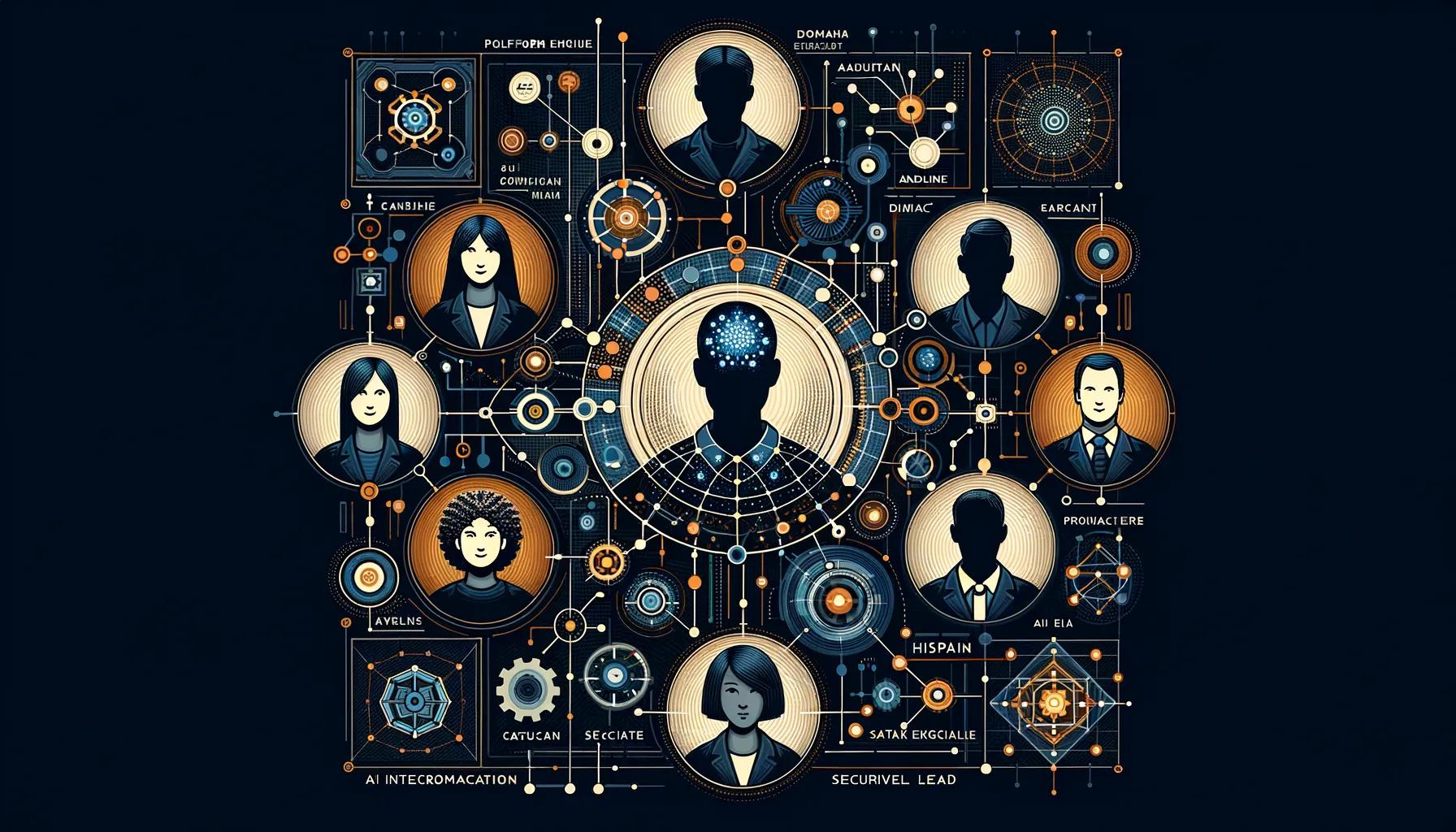
Everyone wants AI automation. Few organizations have the team to actually build it. The gap isn't ambition — it's composition. Most companies either throw their existing engineering team at AI projects (and wonder why nothing reaches production) or hire a single "AI person" and expect miracles.
Neither works. Building reliable AI automation at scale requires a deliberately constructed team with specific, overlapping skills that didn't exist as a coherent discipline three years ago.
Here's what that team actually looks like — based on what we've seen work across enterprise deployments.
The Talent Gap Is Real — and It's the #1 Blocker
This isn't theoretical. According to McKinsey's 2025 report on AI in the workplace, 46% of organizations cite talent skill gaps as the primary reason AI adoption has been too slow. Not budget. Not executive buy-in. Not technology limitations. People.
Deloitte's 2026 "State of AI in the Enterprise" report reinforces this: only 25% of respondents have moved 40% or more of their AI pilots into production. The rest are stuck in experimentation. A major reason? They don't have the right team to bridge the gap between a working prototype and a production system.
The organizations that do scale AI aren't necessarily bigger or better-funded. They have better team composition.
The Six Roles You Actually Need
Forget the inflated org charts with 15 specialized AI roles. For most organizations building AI automation, you need six distinct capabilities. Sometimes one person covers two. Sometimes a role is fractional. But all six must be present.
1. AI/ML Engineer
This is your core builder. Not a data scientist running Jupyter notebooks — an engineer who builds production systems that happen to use AI. They understand:
- Model selection and fine-tuning trade-offs (when to use Claude vs. GPT-4o vs. an open-source model)
- Prompt engineering as software engineering — versioned, tested, reviewed
- RAG architectures, embedding pipelines, and vector stores
- Latency budgets, token economics, and cost optimization
The key distinction: they think in systems, not experiments.
2. Platform/Infrastructure Engineer
AI automation doesn't run on vibes. It runs on infrastructure. This person handles:
- Orchestration layers for multi-step AI workflows
- Sandboxed execution environments for agent tool use
- Observability — structured logging, tracing, cost-per-task dashboards
- CI/CD pipelines that include prompt regression testing
As Gartner's 2026 Strategic Technology Trends notes, AI-native development platforms are enabling "tiny teams of people paired with AI to create more applications with the same level of developers they have today." But those tiny teams need exceptional infrastructure underneath.
3. Domain Expert / Product Owner
This is the person who knows what the AI should actually do — and more importantly, what it should never do. They define:
- Acceptance criteria for AI outputs (what "good enough" looks like)
- Edge cases that models will hallucinate around
- Business rules that must be deterministic, not probabilistic
- Escalation paths when the AI can't handle a case
Research from a Harvard Business School field experiment covered by Fortune found that effective AI collaboration requires "T-shaped" professionals — people who combine deep domain expertise with sophisticated AI interaction skills. Your domain expert doesn't need to write code, but they need to understand what AI can and can't do reliably.
4. Data Engineer
AI automation is only as good as its data access. The data engineer ensures:
- Clean, structured data pipelines feeding AI workflows
- API integrations with CRMs, ERPs, content systems, and internal tools
- Data governance — what the AI can access, what it can't, and audit trails for both
- Context assembly — building the right retrieval layer so the AI has what it needs without drowning in noise
Most failed AI automation projects fail here. The model works fine. The data is a mess.
5. QA/Evaluation Specialist
Traditional QA doesn't work for non-deterministic systems. You need someone who can:
- Build evaluation datasets and scoring rubrics for AI outputs
- Design regression test suites that catch prompt drift
- Monitor production quality metrics — not just "did it respond" but "was it right"
- Red-team the system — find the inputs that break it before users do
This role is the most commonly missing on AI teams, and it's the one that separates systems that work in demos from systems that work in production.
6. Security & Governance Lead
AI automation at scale means AI accessing real systems, real data, and making real decisions. Someone needs to own:
- Prompt injection prevention and input sanitization
- Data classification — ensuring PII/PHI doesn't leak into model contexts
- Agent permission scoping — what actions can the AI take, and with what approval?
- Compliance mapping — SOC 2, HIPAA, GDPR implications of AI-driven processes
Deloitte's research found that close to three-quarters of companies plan to deploy agentic AI within two years, yet only 21% report having a mature model for agent governance. That gap will produce incidents.
Team Structure: Pods Over Departments
The worst thing you can do is isolate these roles into separate departments. The "AI Center of Excellence" that sits apart from the business? It produces research papers, not production systems.
What works: cross-functional pods. A small team (4-7 people) with the six capabilities above, embedded in a specific business domain, shipping real automation on a cadence.
Deloitte's enterprise AI research confirms this pattern: 53% of organizations are now considering pod-based or non-hierarchical models for AI work, as fewer roles require supervision of large teams and more require tight collaboration across disciplines.
The pod structure works because AI automation requires tight feedback loops. The domain expert sees a bad output, the AI engineer adjusts the prompt, the QA specialist validates the fix, the data engineer adjusts the context — all in the same sprint, often the same day.
Build vs. Partner: The Honest Calculus
Not every organization can or should build this team in-house from day one. The honest question is: how quickly do you need to be in production, and how long will you need to sustain it?
Build in-house when:
- AI automation is your core business differentiator
- You have 12+ months to recruit, ramp, and iterate
- The domain knowledge is so specialized that external teams can't ramp fast enough
Partner when:
- You need production AI in weeks, not quarters
- You're building your first AI automation and don't yet know what "good" looks like
- You want to leapfrog the pilot-to-production gap that traps the majority of organizations
The smart play is often both: partner to get the first systems into production, then build internal capability by working alongside the partner team. Knowledge transfer happens by shipping together, not by reading documentation.
Skills That Matter More Than Titles
Regardless of how you build the team, hire for these attributes over specific titles:
Systems thinking over model expertise. Someone who can design a reliable end-to-end workflow matters more than someone who can fine-tune a model 2% better.
Production instincts over research instincts. The question "what happens when this fails at 3am?" is more valuable than "what if we tried a different architecture?"
Pragmatism over perfectionism. The team that ships an 85%-accurate automation with proper fallbacks beats the team still tuning for 99% accuracy in a lab.
Communication over isolation. As McKinsey advises for the agentic AI era, organizations need to redefine roles to include "agentic literacy, integrative problem solving, and human skills." The best AI teams are the ones where engineers can explain trade-offs to business leaders and business leaders can articulate requirements to engineers.
What We've Learned at Last Rev
We've built AI automation across multiple enterprise environments, and the pattern is consistent: the technology is rarely the bottleneck. The team is.
The deployments that reach production fastest share these characteristics:
- A domain expert is embedded in the team from day one — not consulted occasionally
- Evaluation infrastructure is built before the first feature, not after the first incident
- The team has shipped AI to production before and knows the failure modes (see our post on building AI agents that work in production)
- Governance isn't an afterthought — permissions, audit trails, and escalation paths are designed into the architecture
The deployments that stall share a different pattern: a strong AI engineer working alone, no QA process for AI outputs, domain experts consulted after the fact, and security review happening right before launch (killing the timeline).
Key Takeaways
- Six capabilities, not six departments: AI/ML engineering, platform/infrastructure, domain expertise, data engineering, AI-specific QA, and security/governance
- Pods beat org charts: Cross-functional teams of 4-7 people, embedded in the business, shipping on a cadence
- The talent gap is real: 46% of organizations cite it as the #1 blocker to AI adoption
- Evaluation is the missing role: Most teams skip AI-specific QA and pay for it in production
- Partner to accelerate, build to sustain: The fastest path is often shipping with a partner while building internal capability
Building reliable AI automation at scale isn't a technology problem anymore. It's a team design problem. Get the composition right, and the technology follows.
Sources
- McKinsey — "Superagency in the workplace: Empowering people to unlock AI's full potential at work" (2025)
- Deloitte AI Institute — "State of AI in the Enterprise: The Untapped Edge" (2026)
- Gartner — "Top Strategic Technology Trends for 2026" (2025)
- Fortune / Harvard Business School — "The Cybernetic Teammate: How AI Is Rewriting the Rules of Business Collaboration" (2025)
- McKinsey — "Rethink Management and Talent for Agentic AI" (2025)
- Deloitte — "The State of AI in the Enterprise" (2026)