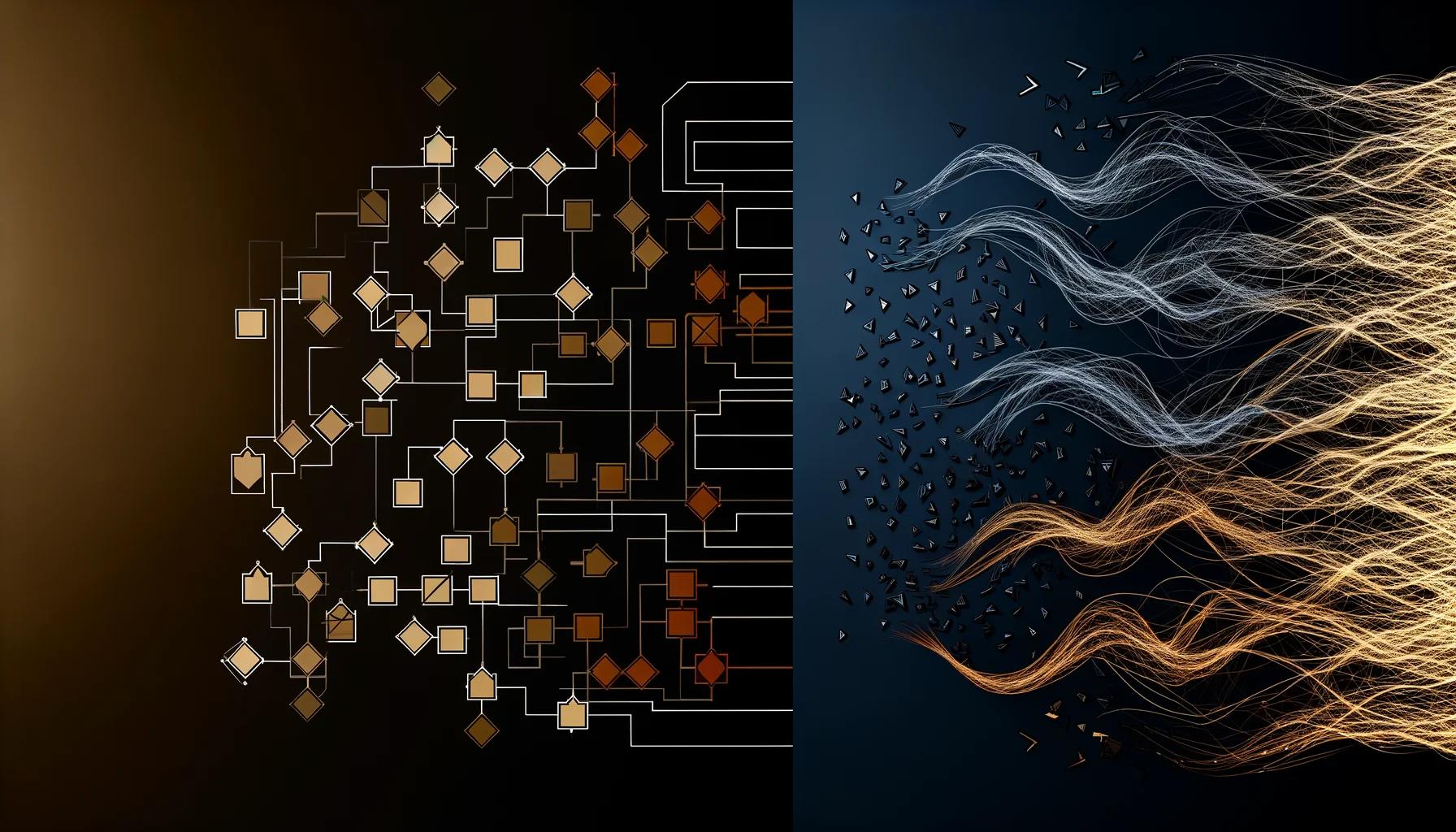
Remember when every automation platform looked like a flowchart? Zapier, n8n, Make, Flowise — all beautiful node-based interfaces that promised "no-code AI workflows." They had their moment. That moment is ending.
The Visual Workflow Trap
Drag-and-drop workflow builders are great for simple automations: "When email arrives → extract attachment → save to Drive." Linear. Predictable. Easy to visualize.
But AI workflows aren't linear. They're adaptive, branching, self-correcting systems that need to:
- Make decisions based on nuanced context
- Retry with different strategies when something fails
- Maintain state across complex multi-step operations
- Compose tools dynamically based on the task
- Handle edge cases that the designer never anticipated
Try representing that in a node graph. You can't — at least not without the graph becoming an unreadable spaghetti diagram that's harder to maintain than the code it was supposed to replace.
The Skills-Based Architecture
The winning pattern we're seeing is what we call "skills-based architecture." Instead of visual workflows, you give an AI agent a set of discrete skills — modular, well-documented capabilities that the agent can compose on the fly.
A skill is just code: a function with a clear interface, documented inputs/outputs, and error handling. The agent decides which skills to use, in what order, based on the task at hand.
A visual workflow says "always do these steps in this order." A skills-based agent says "here's what I can do — let me figure out the best approach for this specific situation."
Why Code Wins
Version control. Code lives in Git. You get history, diffs, branches, code review, and rollback. Visual workflow JSON exports are barely readable.
Testing. You can write unit tests for skills. You can run integration tests. You can build regression suites. Good luck testing a node graph programmatically.
Composition. Skills can call other skills. They can be parameterized. They can share utilities. Visual nodes are isolated by design.
Debugging. When something goes wrong in code, you get stack traces, breakpoints, and logging. When something goes wrong in a visual workflow, you get... a red node.
AI can write code. This is the kicker. AI is excellent at writing and modifying code. It's terrible at manipulating visual node graphs. If you want AI to improve its own workflows, code is the only viable substrate.
The Counterargument
"But non-technical users need visual builders!" Maybe. But the users building AI workflows are almost never non-technical. They're developers, data engineers, and ops teams. Giving technical users a visual builder is like giving a chef a microwave — it works, but it's not the right tool.
For truly non-technical users, the answer isn't a visual builder — it's a natural language interface backed by a code-first system. "Set up a workflow that..." is more accessible than any node graph.
What This Means for Your Stack
If you're currently using a visual workflow builder for AI automation:
- Keep it for simple automations. Zapier-style triggers are fine for linear workflows.
- Move AI-heavy workflows to code. Anything involving LLM reasoning, multi-step decisions, or dynamic tool use should be in a code-first framework.
- Invest in your skills library. Build reusable, well-tested skills that agents can compose. This is your competitive moat.
The future of AI automation is adaptive, not prescribed. Code-first architectures are how you get there.